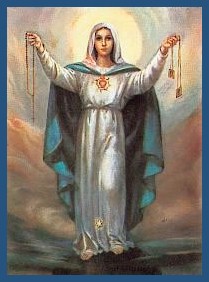
Mater mitis sed viri nescia Carmeliti sesto propitia stella maris.
July 16th - Feast of Our Lady of Mount Carmel
 This feast was instituted by the Carmelites between 1376 and 1386 under the title "Commemoratio B. Marif Virg. duplex" to celebrate the victory of their order over its enemies on obtaining the approbation of its name and constitution from Honorius III on 30 Jan., 1226 (see Colvenerius, "Kal. Mar.", 30 Jan. "Summa Aurea", III, 737). The feast was assigned to 16 July, because on that date in 1251, according to Carmelite traditions, the scapular was given by the Blessed Virgin to St. Simon Stock; it was first approved by Sixtus V in 1587. After Cardinal Bellarmine had examined the Carmelite traditions in 1609, it was declared the patronal feast of the order, and is now celebrated in the Carmelite calendar as a major double of the first class with a vigil and a privileged octave (like the octave of Epiphany, admitting only a double of the first class) under the title "Commemoratio solemnis B.V.M. de Monte Carmelo". By a privilege given by Clement X in 1672, some Carmelite monasteries keep the feast on the Sunday after 16 July, or on some other Sunday in July. In the seventeenth century the feast was adopted by several dioceses in the south of Italy, although its celebration, outside of Carmelite churches, was prohibited in 1628 by a decree contra abusus. On 21 Nov., 1674, however, it was first granted by Clement X to Spain and its colonies, in 1675 to Austria, in 1679 to Portugal and its colonies, and in 1725 to the Papal States of the Church, on 24 Sept., 1726, it was extended to the entire Latin Church by Benedict XIII. The lessons contain the legend of the scapular; the promise of the Sabbatine privilege was inserted into the lessons by Paul V about 1614. The Greeks of southern Italy and the Catholic Chaldeans have adopted this feast of the "Vestment of the Blessed Virgin Mary". The object of the feast is the special predilection of Mary for those who profess themselves her servants by wearing her scapular
 source : Catholic Encyclopedia
Author: Frederick G. Holweck
Prayer
Blessed Mother of the Son of God, Immaculate Virgin, assist me in this my
necessity. O Star of the Sea, help me and show me herein you are my Mother. O
holy Mary, Mother of God, Queen of Heaven and Earth, I humbly beseech you from
the bottom of my heart, to succour me in this necessity; there are none that can
withstand your power.
Amen
Saint Elijah Prophet & Our Father

Prayer
Almighty, ever‑living God, your prophet Elijah, our Father,
lived always in your presence and was zealous for the honour due to your name.
May we, your servants, always seek your face and bear witness to your love.
We ask this grace through our Lord Jesus Christ, who lives and reigns with you in the unity of the Holy Spirit, One God, for ever and ever.
source - carmelite province - Ireland
Life
The Troparion of his feast calls him "a pillar of prophets, and the second Forerunner of the coming of Christ." Because, as Scripture tells us, he was taken to heaven in a fiery chariot, the Jewish people felt that he did not die as mortals do, and that some day he would return to earth to "restore the tribes of Israel." (Ecclus. 48: 10) Indeed, some people considered that Jesus Christ was actually the returned Elias.
Icons depicting Elias usually show him in a chariot drawn by fiery horses heading heavenward and his cloak or mantle falling earthward into the outstretched arms of Elisha his companion and disciple, signifying the transfer of his power and authority of a prophet.
His many miracles can easily be rendered in symbols:
rain ending a seven year drought; fire from heaven consuming his water drenched altar with its offering of a bull while the altar of the pagan priests, dry and ready, could not be ignited by incessant prayers to the pagan god Baal. There was also the widow of Sarephath whose two containers of oil and meal he kept repeatedly full through prayer, and then raised her son from a sudden death. On one occasion Elias, in order to cross the River Jordan, struck the waters with his cloak; the waters parted and he and Elisha were able to cross to the other side. At another time, while in hiding from persecutors, he hid by the Brook of Cherith and there, was miraculously fed by ravens.
To learn more details about these miraculous events we suggest you read Kings I, and Kings II of the Old Testament.
Elias was one of the greatest and most remarkable prophets of the Old Testament. Of his origin, not much is known, except that he was a Thesbite. He appeared on the historical scene during the reign of Achab (9 cent. B.C.). He delivered to that impious king the message of Yahweh: Israel would be punished by a long drought and Achab’s house would fall. He then lived to see the tragic end of Achab. Next we hear of Elias in connection with Ochozias, Achab’s son and successor, to whom he predicted that the injuries received in a fall would be fatal. The end of the earthly life of Elias came mysteriously. As he was conversing with Eliseus on the hills of Moah, "a fiery chariot, and fiery horses parted them both asunder, and Elias went up by a whirlwind into heaven" ( Kings. 2:11) Jews, Christians and Moslems pay high honor to Elias; Carmelite monks cherish the belief that their order was in some sense founded by him. Together with Moses, he appeared at Christ’s transfiguration.
The veneration of Elias dates back to apostolic times. In the fourth century, the feast was already generally known. St. John Chrysostom, St. Ambrose and St. Augustine have testified to his greatness, a fact which alone would prove the antiquity of this feast.

"478 Jesus knew and loved us each and all during his life, his agony and his Passion, and gave himself up for each one of us: "The Son of God. . . loved me and gave himself for me." He has loved us all with a human heart. For this reason, the Sacred Heart of Jesus, pierced by our sins and for our salvation, "is quite rightly considered the chief sign and symbol of that. . . love with which the divine Redeemer continually loves the eternal Father and all human beings" without exception. "
Catechism of the Catholic Church.
"The worship, although paid to the Heart of Jesus, extends further than the Heart of flesh, being directed to the love of which this Heart is the living and expressive symbol." Catholic Encyclopedia.
The month of June, as all Catholics know, is the month of the Sacred Heart. During it the Church urges the faithful to special zeal in the worship of the Heart of our Saviour, considered as a part of His sacred Humanity and as the emblem of His infinite love.
The devotion to the Sacred Heart is one which has become widely known only since the seventeenth century; and it was not sanctioned by the Church for general use until the latter part of the eighteenth. Though it is now recognized as an important elenient in Catholic worship, it met with strenuous opposition when it was first introduced - not only from the
Jansenists (who had fallen into error regarding many doctrines of the Church) but from earnest Catholics who object to the new doctrine because they misunderstood it.
Saint Margaret Mary Alacoque.
Homage paid to the Heart of Jesus is mentioned by spiritual writers as early as the twelfth century; but it was practised to a very limited extent until a little more than two hundred years ago. A humble and holy French nun, the saintly Margaret Mary Alacoque, within the space of a religious life of only nineteen years, instituted a devotion which bids fair to last forever. She became the apostle of the beautiful and now universal worship of the loving Heart of our Blessed Saviour.
She was born in the village of Lhautecour, in France, in the year 1647, and lived until 1690. After a childhood remarkable for sanctity, she entered the community of the Visitation nuns at Paray-le-Monial in 1671. Here she lived a life of mortification and prayer, and in return for her fidelity and fervor our Divine Lord is said to have [granted] her a privilege which He has frequently given to other holy souls. He appeared to her on several occasions; and in one of these visions He showed her His Heart, pierced with a wound, encircled with a crown of thorns, surrounded by flames and surmounted by a cross - as we see it usually represented in pictures and statues at the present day. He commanded her to practise and to teach others the devotion to His Sacred Heart, because of His ardent desire to be loved by men and His wish to give to all mankind the treasures of His love and mercy. [See ccc 67 on private revelation.]
The pious nun sought the counsel of her superiors, and the account of her visions was received at first with incredulity. All her actions and her teachings were subjected to a most severe examination, and it was long before any approval was given to the devotion which she was endeavoring to establish. But the will of God cannot be opposed. The devotion spread rapidly through France, and was gradually established in other parts of the world. It did not at first receive the approbation[i.e. official approval] of the Holy See, for our Church is cautious in giving her sanctions to anything that savors of novelty in religion, and makes a long and careful scrutiny before she recommends a new devotion to her children. In 1794, however, Pius VI issued a decree approving the devotion to the Sacred Heart and granting indulgences to those who practise it.
The Feast of the Sacred Heart.
Attempts had been made, in 1697 and in 1729, to have a day set apart in honor of the Sacred Heart, but on both occasions the proposal was rejected by the Roman Congregation of Rites. In 1765, however, a number of churches were permitted to celebrate this feast, and in 1856 this permission was extended to the whole world, and the feast was fixed on the day after the festival of Corpus Christi, in the month of June. In 1889, under Leo XIII, the day was raised to a higher rank in the Church's calendar, and all mankind was solemnly consecrated to the Sacred Heart of Jesus. On account of the importance of this great June festival, the whole month of June is considered as being specially devoted to the worship of the Sacred Heart.
Margaret Mary Alacoque was pronounced Venerable by Leo XII in 1824, and was honored with the title of Blessed by Pius IX in 1864. Through her intercession many miracles have been performed, especially at the place of her burial; and on account of these and of the great devotion which she established, her name has been placed on the calendar of the Church's Saints, and her virtues will be henceforth venerated by all Catholics. She was declared a Saint by Pope Benedict XV in 1920.
We shall state briefly the Catholic doctrine regarding the worship of the Sacred Heart. It is not a mere relative homage, such as we give to holy things or to holy persons. It is not the higher form of religious veneration, such as we pay to the Blessed Mother of God. It is supreme adoration, because it is paid to the physical Heart of Christ, considered not as mere flesh, but as united to the Divinity. We Catholics adore that Heart as the Heart of Christ, an inseparable part of Him. All the members of Christ are or may be the object of divine worship, because they are a part of His human nature and are thereby united to the Divine Nature of the Second Person of the Blessed Trinity.
482 Christ, being true God and true man, has a human intellect and will, perfectly attuned and subject to his divine intellect and divine will, which he has in common with the Father and the Holy Spirit. 483 The Incarnation is therefore the mystery of the wonderful union of the divine and human natures in the one person of the Word."]
But why is the Heart of Jesus selected as the object of this special adoration? Because His real and physical Heart is a natural symbol of the infinite charity of the Saviour and of His interior and spiritual life. The heart is a vital organ which, as it throbs within us, is part of our existence. It has always been looked upon as an emblem, sometimes of courage, sometimes of one's whole interior nature, but oftener of love. How often we hear such expressions as "Be of good heart," meaning "Have courage"; " He opened his heart to me," meaning " He told me all his secrets "; and our Lord Jesus, in asking our love, made the request in these words, "Son, give me thy heart." We see, then the reasonableness of taking the Sacred Heart of our Saviour as an object of our worship, not only because it is a part of Him, but because it symbolizes His love for all mankind. ["The heart is the seat of the moral personality..."
From early times the Five Wounds of our Lord were venerated as the symbol of His Passion, and this devotion received the approbation of the Church. In like manner, in these later days, she has seen fit to sanction and recommend the worship of the Sacred Heart of Jesus and to urge her children to offer their homage to that symbol of our Saviour's love, wherewith "He has loved us even to the end."
[ccc 2669 "The prayer of the Church venerates and honors the Heart of Jesus just as it invokes his most holy name. It adores the incarnate Word and his Heart which, out of love for men, he allowed to be pierced by our sins. Christian prayer loves to follow the way of the cross in the Savior's steps. The stations from the Praetorium to Golgotha and the tomb trace the way of Jesus, who by his holy Cross has redeemed the world. "]
A Symbol of Love.
We must remember, then, that while this devotion is directed to the material Heart of our Blessed Lord, it does not stop there. It includes also a spiritual element - namely, the infinite love of Jesus for us, which is recalled and symbolized by His Sacred Heart. [See ccc 478.]
There is no devotion that has been extended throughout the Catholic world in so short a time. This means of realizing and honoring the all-embracing love of our Blessed Saviour would seem to have filled a long-felt want in the hearts of the devout faithful...
The First Fridays.
One of the greatest factors not only in making the worship of the Sacred Heart known but in distributing its spiritual benefits is the " Devotion of the First Fridays." The faithful are exhorted to receive Holy Communion on the first Friday of each month for nine months in succession, by which they may gain a plenary indulgence; and in many churches and chapels the exposition of the Blessed Sacrament takes place, either during the whole day or in the evening, and special services are held in honor of our Eucharistic Lord and especially of His Sacred Heart, the symbol of His unutterable love for us whom He died to save." [See
source : Rev. John F. Sullivan, The Externals of the Catholic Church, Kenedy & Sons (1917) pp. 243-47. Imprimatur +John Cardnal Farley, Archbishop of NY, 3/27/1918. References to the catechism and material in brackets are provided by the editor. The image above was obtained from the NY Sacred Heart Apostolate.

This Christian custom of dedicating the month of May to the Blessed Virgin arose at the end of the 13th century. In this way, the Church was able to Christianize the secular feasts which were wont to take place at that time. In the 16th century, books appeared and fostered this devotion.
The practice became especially popular among the members of the Jesuit Order — by 1700 it took hold among their students at the Roman College and a bit later it was publicly practiced in the Gesu Church in Rome. From there it spread to the whole Church.
The practice was granted a partial indulgence by Pius VII in 1815 and a plenary indulgence by Pius IX in 1859. With the complete revision of indulgences in 1966 and the decreased emphasis on specific indulgences, it no longer carries an indulgence; however it certainly falls within the category of the First General Grant of Indulgences. (A partial indulgence is granted to the faithful who, in the performance of their duties and in bearing the trials of life, raise their mind with humble confidence to God, adding — even if only mentally — some pious invocation.
Excerpted from Enchiridion of Indulgences.
The Month of Mary and the Popes
The pious practice of honoring Mary during the month of May has been especially recommended by the Popes. Pius XII made frequent reference to it and in his great Encyclical on the Sacred Liturgy (Mediator Dei) characterized it as one of "other exercises of piety which although not strictly belonging to the Sacred Liturgy, are nevertheless of special import and dignity, and may be considered in a certain way to be an addition to the liturgical cult: they have been approved and praised over and over again by the Apostolic See and by the Bishops" (no. 182).
Paul VI wrote a short encyclical in 1965 using the Month of Mary devotion as a means of obtaining prayers for peace. He urged the faithful to make use of this practice which is "gladdening and consoling" and by which the Blessed Virgin Mary is honored and the Christian people are enriched with spiritual gifts" (no. 2).
In May of 2002 Pope John Paul II said, "Today we begin the month dedicated to Our Lady a favourite of popular devotion. In accord with a long-standing tradition of devotion, parishes and families continue to make the month of May a "Marian" month, celebrating it with many devout liturgical, catechetical and pastoral initiatives!"
Devotion to Mary
The Blessed Virgin Mary is the Mother of the Church and therefore the example, as well as the guide and inspiration, of everyone who, in and through the Church, seeks to be the servant of God and man and the obedient agent of the promptings of the Holy Spirit.
The Holy Spirit, as Pope Leo XIII reminded us, is the soul of the Church: All the activity and service of the members of the Church, beginning with the supreme participation of the Blessed Mother in the work of the Church, is vivified by the Holy Spirit as the body, in all its activities, is vivified by its soul. The Holy Spirit is the Paraclete, Advocate, and Comforter which Christ Himself sent to be our consolation in the sorrowful mysteries of life, our source of moderation in the joyful mysteries of life, our added principle of exaltation in the glorious mysteries of life.
So He was for the Blessed Mother; so also He is for the least of us; so also He is for the rest of the Church, even for those who are its unconscious but conscientious members.
Wherever there is faith there is the example of Mary, because she lived by faith as the Scriptures remind us....
If, then, piety is the virtue which binds us to the sources of all life, to God, to our parents, to the Church, to Christ, certainly Christian piety binds us, in grateful love, to Mary — or our acceptance of Christ and of the mystery of our kinship with Him is imperfect, partial, and unfulfilled. — Cardinal John Wright
Mary and Our Spiritual Life
In our observance of the Marian month we should take into account the season of the Liturgical Year which largely corresponds with the fifty days of Easter. Our pious exercises could emphasize Our Lady's participation in the Paschal mystery and in Pentecost with which the Church begins. The pious exercises connected with the month of May can easily highlight the earthly role played by the glorified Queen of Heaven, here and now, in the celebration of the Sacraments of Baptism, Confirmation and Holy Eucharist.
The following practices which are recommended by the Magisterium are offered as suggestions for honoring Our Lady during Her month.
The Regina Coeli
The ecclesial community addresses this antiphon to Mary for the Resurrection of her Son. It adverts to, and depends on, the invitation to joy addressed by Gabriel to the Lord's humble servant who was called to become the Mother of the saving Messiah.
The Rosary
Also called the Psalter of the Blessed Virgin Mary, the Rosary is one of the most excellent prayers to the Mother of God. Thus, "the Roman Pontiffs have repeatedly exhorted the faithful to the frequent recitation of this biblically inspired prayer which is centered on contemplation of the salvific events of Christ's life, and their close association with the Virgin Mother."
Litanies of the Blessed Virgin Mary
These consist of a long series of invocations to Our Lady, which follow in a uniform rhythm, thereby creating a stream of prayer characterized by insistent praise and supplication.
Consecration and Entrustment to Mary
The Roman Pontiffs have frequently expressed appreciation for the pious practice of "consecration to the Blessed Virgin Mary" and the formulas publicly used by them are well known.
Louis Grignon de Montfort is one of the great masters of the spirituality underlying the act of "consecration to Mary". He "proposed to the faithful consecration to Jesus through Mary, as an effective way of living out their baptismal commitment."
The Brown Scapular and other Scapulars
The scapular is an external sign of the filial relationship established between the Blessed Virgin Mary, Mother and Queen of Mount Carmel, and the faithful who entrust themselves totally to her protection, who have recourse to her maternal intercession, who are mindful of the primacy of the spiritual life and the need for prayer.
Medals
These are witnesses of faith and a sign of veneration of the Holy Mother of God, as well as of trust in her maternal protection.
The Church blesses such objects of Marian devotion in the belief that "they help to remind the faithful of the love of God, and to increase trust in the Blessed Virgin Mary."
source : www.catolicculture.org
=================================================================
 Pious Practices For Lent
 source : Tom Nelson - Publisher: TAN Books & Publishing (www.tanbooks.com)
Every Lent, Holy Mother The Church advocates certain pious practices that her children should perform to satisfy their requirements to do penance, to pray, to perform good works, to make reparation for their sins, and to further the apostolic work of the Church.
Our Lord tells us, as recorded in Scripture, "Unless you shall do penance, you shall all likewise perish" (Luke 13:3). And St. John the Baptist announced the coming of the Saviour with the ominous admonition, "Do penance: for the kingdom of heaven is at hand." (Matt. 3:2).
With regard to prayer, St. Paul tells us to "Pray without ceasing." (1 Thess. 5:17). And Our dear Lord advises us, "Amen, amen I say to you: if you ask the Father anything in my name, he will give it you." (John 16:23). Also He said, "If you abide in me [i.e., "live in Me," or "stay in the state of grace"], and my words abide ["live"] in you, you shall ask whatever you will, and it shall be done unto you." (John 15:7). Further, Our Lord has said, "Watch ye, therefore, praying at all times, that you may be accounted worthy to escape all these things that are to come, and to stand before the Son of man." (Luke 21:36). And in the Book of Judith we read, "Know ye that the Lord will hear your prayers, if you continue with perseverance in fastings and prayers in the sight of the Lord." (Judith 4:11).
Our obligation to do apostolic work, no matter who we are, is seen in the general admonition of St. John the Baptist, ". . .make straight the way of the Lord . . ." (In. 1:23; Is. 40:3). The Church has used this counsel in her Advent liturgy, so we know it applies to all-at least to the extent that all must pray and do penance for the success of the Church's missionary activity, help support it financially-and wherever possible take an active part in the conversion or reconversion of those we know.
The primary purpose of Lent, of course, is to help us become truly holy-and we should work toward this goal during Lent by extra prayer, penance, good works, almsgiving, attendance at Mass and reception of the Sacraments (the chief sources of grace).
SPECIFIC PRACTICES TO CHOOSE FROM
1. Abstinence: This is the giving up of something we like to eat, drink, smoke, use, etc. (All Catholics 14 and over are currently required to abstain from meat on Ash Wednesday and all the Fridays of Lent.) We can abstain from (give up) meat on days other than those required, give up candy, sweets, dessert, pop, gum, coffee, tea, smoking, beer, wine, hard liquor, eating between meals, and/or our favorite foods and drinks, etc.
2. Fasting: This is still required by the Church of all those age 21 through 59 on Ash Wednesday and Good Friday, but it is something which most people can do every day during Lent (except Sunday, which was never a day of fasting). This was formerly required of all Catholics 21 through 59 years of age. The Catholic Church's traditional method of fasting is to take only one full meal per day, at which meat may be eaten (unless it is also a day of abstinence), plus 2 small meals that together do not equal the main meal and at which no meat is eaten, with nothing eaten between meals. This is a mild form of fasting, but one which leaves the person always a little on the hungry side and ever cognizant that he is depriving himself of his regular fare.
3. TV: We can drastically limit our TV viewing, give up favorite programs or eliminate it altogether.
4. Prayer:
- The daily Rosary. Our Lady urgently requested the daily recitation of the Rosary (5 decades) during each of her appearances at Fatima.
- The First Saturday devotion, requested by Our Lady at Fatima.
With regard to this devotion, Our Lady revealed to Sr. Lucy of Fatima on December 10, 1925, "I promise to assist at the hour of death, with the graces necessary for salvation, all those who on the First Saturday of 5 consecutive months shall confess, receive Holy Communion, recite 5 decades of the Rosary, and keep me company for 15 minutes, while meditating on the 15 mysteries of the Rosary, with the intention of making reparation to me." (A later revelation indicated that the Confession may be 8 days before or after the First Saturday and the meditation on the mysteries of the Rosary may be on as few as one of the mysteries and does not need to be performed before the Blessed Sacrament.).
- An extra Mass or more each week. The Holy Sarcrifice of the Mass is the greatest prayer there is.
- A Holy Hour, once a week, twice a week, or each day.
This is one of the most underrated devotions in the Church. Our Lord Himself has said, "Could you not watch one hour with me?" (Matt. 26:40). Granted, this was addressed to the Apostles in the Garden of Olives the night before He was crucified, but it can be applied to all of us generallyand how very, very few practice this powerful devotion! Archbishop Fulton Sheen made it the center of his daily devotions, after the Mass.
- Pray for those in Purgatory. We have an obligation to pray for our relatives and for anyone we may have harmed by our sins. A Rosary before the Blessed Sacrament after Mass is extremely efficacious for the Poor Souls and can lead to the gaining of a plenary indulgence-all other conditions for this being fulfilled.
- Pray for those who are in danger of dying without being in the state of Sanctifying Grace. Such prayers should be offered to Our Lady to apply as she desires, for she sees clearly who really needs the extra graces at any given time.
- Pray for anyone you may have had the misfortune to lead into sin.
- Pray for an end to abortion.
- Pray for peace in the world. The Old Testament tells us, "The heart of the king is in the hand of the Lord: whithersoever he will, he shall turn it." (Prov. 21:1). Prayer can work miracles and change the hearts of even wicked rulers.
5. Go to Confession once a week: Frequent Confession is generally said to be once a month, but in Introduction to the Devout Life St. Francis de Sales recommends once a week, and St. Alphonsus Liguori says that anyone who is serious about saving his soul will go often, "at least once a week." Some Saints went every day; many went several times a week. Just prior to Vatican II, priests in the U.S.A. were advocating once a week and getting about 1/3 to 1/2 compliance by the people. This is one of the best ways to make progress in the spiritual life because we regularly stay focused on what we are doing wrong.
6. Examine your conscience every night: Review the day and what you did and did not do that might have displeased God; then, keep these things in mind for your next Confession.
7. Do penance: Our Lord has made it perfectly clear that penance is necessary for salvation. (See the quotes from Scripture above.) To Sr. Lucy of Fatima, He revealed that "The penance I now ask and require is that necessary for the fulfillment of My law and the performance of one's daily duties."
8. Perform good works:
- Visit the sick.
- Visit people in nursing homes once a week.
- Counsel, picket or pray at abortion clinics.
- Join in the abortion rescue effort.
- Take someone to Mass with you on Sundays.
- Get someone with a marriage problem to see a priest.
9. Give alms:
- Increase your donation at Church.
- Give to cloistered monasteries and convents in your area.
- Support good Catholic schools.
- Support crisis pregnancy centers.
- Support local soup kitchens.
- Help those who are poor.
10. Do Apostolic work:
- Take someone to Mass with you.
- Take someone to Confession with you.
- Invite someone to become a Catholic-start talking to him about it.
- Get him to a priest for instruction.
- Get a priest to visit a fallen-away Catholic, especially an elderly one.
- Distribute Catholic books and booklets. (TAN has many titles that are discounted specifically for this purpose.)
- Distribute prayer cards and leaflets. (TAN has over a dozen of these, drastically discounted for wide distribution, plus small flyers announcing Catholic books.)
11. Engage in spiritual reading:
- Require yourself to do at least 15 minutes of reading from a good Catholic book each day.
- Read your Bible at least 15 minutes each day.
- Read from the life of a Saint for at least 15 minutes each day. (These are the heroes and heroines we should imitate.)
12. Consecrate your life to God and renew the consecration each day. Or, consecrate yourself to God through the Blessed Virgin Mary and read about and begin to practice "True Devotion to Mary." Read St. Louis De Montfort's book called True Devotion to Mary, one of the Church's greatest classics.
REMEMBER: Lent is a holy season set aside by the Church during which we are recommended to do extra prayer, penance, sacrifice, good works and almsgiving, plus to frequent the Sacraments and attend Mass more often-all for the welfare of our souls. And we should all keep before our minds that many a pious practice begun during Lent has become a lifelong virtuous habit that has thereby helped to perfect those who have made a mere "humble beginning" during Lent.
From Tom Nelson - Publisher: TAN Books & Publishing (www.tanbooks.com)